Hospital Generator Fueling in Houston: Case Study
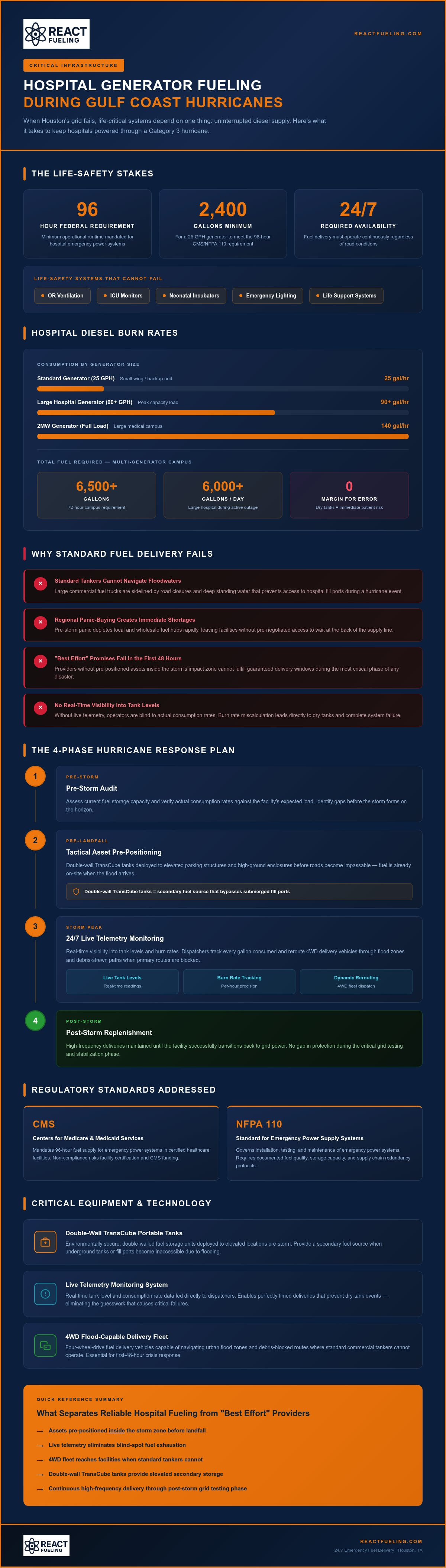
A generator burning 25 gallons per hour requires at least 2,400 gallons of diesel to meet the federal 96-hour operational requirement during a catastrophic power failure. This high-stakes reality makes hospital generator fueling houston a matter of life safety rather than simple logistics. For healthcare administrators, the stress of hurricane season isn't just about the wind. It's the complexity of maintaining life-critical systems when supply chains fracture and roads flood. You understand that a "best effort" delivery promise doesn't cut it when patient lives depend on uninterrupted power.
This case study reveals how specialized fuel logistics ensure facilities remain operational through the most severe outages. You'll discover how the combination of live telemetry monitoring and pre-positioned equipment, like double-wall TransCube tanks, provides the certainty needed to meet CMS and NFPA 110 standards. We'll walk through the exact steps a vigilant fueling partner takes to navigate flooded infrastructure, providing the real-time visibility and 24/7 reliability required to keep your facility's heartbeat steady when the grid goes dark.
The Critical Role of Backup Power in Houston Healthcare Facilities
In the Texas Medical Center and across the Greater Houston area, hospital generator fueling houston is more than a utility; it's a mission-critical logistics service that preserves life. When the municipal grid fails during a hurricane or severe storm, an Emergency power system must engage within seconds. This transition protects the "Life-Safety" load, which includes operating room ventilation, ICU monitors, and neonatal incubators. These systems cannot flicker or fail without immediate, catastrophic consequences for patient care.
Houston’s unique geography presents specific risks that complicate energy resilience. Hurricane-induced grid failures often coincide with localized flooding, turning streets into impassable waterways. During these extended outages, a facility's power strategy shifts from "standby" to "prime" power. This means the generators become the primary source of electricity for days or weeks. Maintaining this state requires a high-velocity generator fueling service that operates with total precision, regardless of the weather conditions outside the hospital walls.
Why Traditional Fuel Delivery Fails During Houston Disasters
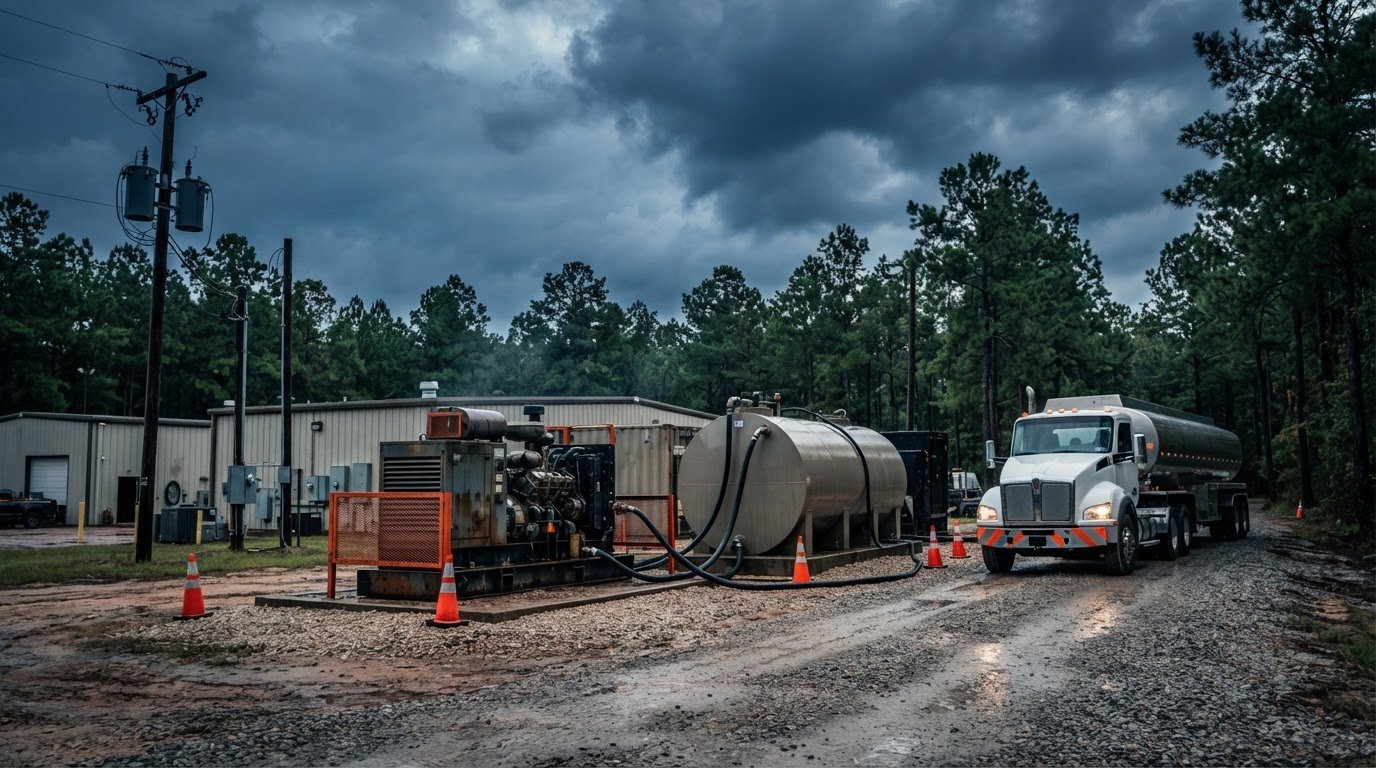
Standard fuel logistics models often break down when they're needed most. Traditional tanker trucks are frequently sidelined by road closures or deep standing water that prevents access to facility fill ports. Additionally, regional panic-buying during major weather events creates immediate shortages at local retail and wholesale hubs, leaving unprepared facilities at the back of the line. Relying on "guaranteed" delivery windows from providers who lack pre-positioned assets is a significant risk. Without dedicated resources already inside the storm's impact zone, these promises often go unfulfilled during the first 48 hours of a crisis.
Load Calculations: Understanding Hospital Diesel Consumption
Calculating fuel demand is the first step in ensuring operational continuity. Large-scale hospital generators frequently consume 90 gallons or more per hour when running at peak capacity. For a typical multi-generator campus, a 72-hour requirement can easily exceed 6,500 gallons of diesel, necessitating a robust and rapid replenishment plan. Accuracy in these figures is vital because underestimating the burn rate leads to dry tanks and system failure.
A 2MW generator at full load typically sustains a burn rate of approximately 140 gallons per hour.
React Fueling utilizes live telemetry to monitor these consumption rates in real-time. This technology allows our dispatchers to see exactly when levels drop, ensuring that every emergency fuel delivery is timed perfectly to prevent downtime. By using double-wall TransCube tanks, we provide additional on-site storage that is both environmentally secure and ready for immediate use.
Case Study: Managing Fueling Logistics During a Gulf Coast Hurricane
Managing a hospital’s power during a Category 3 hurricane requires a disciplined, four-phase logistical response. It begins with Phase 1: The Pre-Storm Audit. In this stage, we assess current fuel storage capacity and verify consumption rates against the facility's expected load. Phase 2 involves the tactical pre-positioning of assets. By moving equipment before the storm makes landfall, we ensure that fuel is already on-site when roads become impassable. Phase 3 transitions into 24/7 live telemetry monitoring during the storm’s peak, tracking every drop consumed. Finally, Phase 4 focuses on post-storm replenishment, maintaining the generators until the municipal grid is fully stabilized and tested.
This structured approach aligns with Best Practices on Energy Resilience for Healthcare Facilities, which emphasizes the need for redundancy and proactive supply chain management. By treating fuel as a dynamic resource rather than a static backup, Houston hospitals can navigate extended outages with total confidence.
The Pre-Positioning Strategy: Beating the Flood
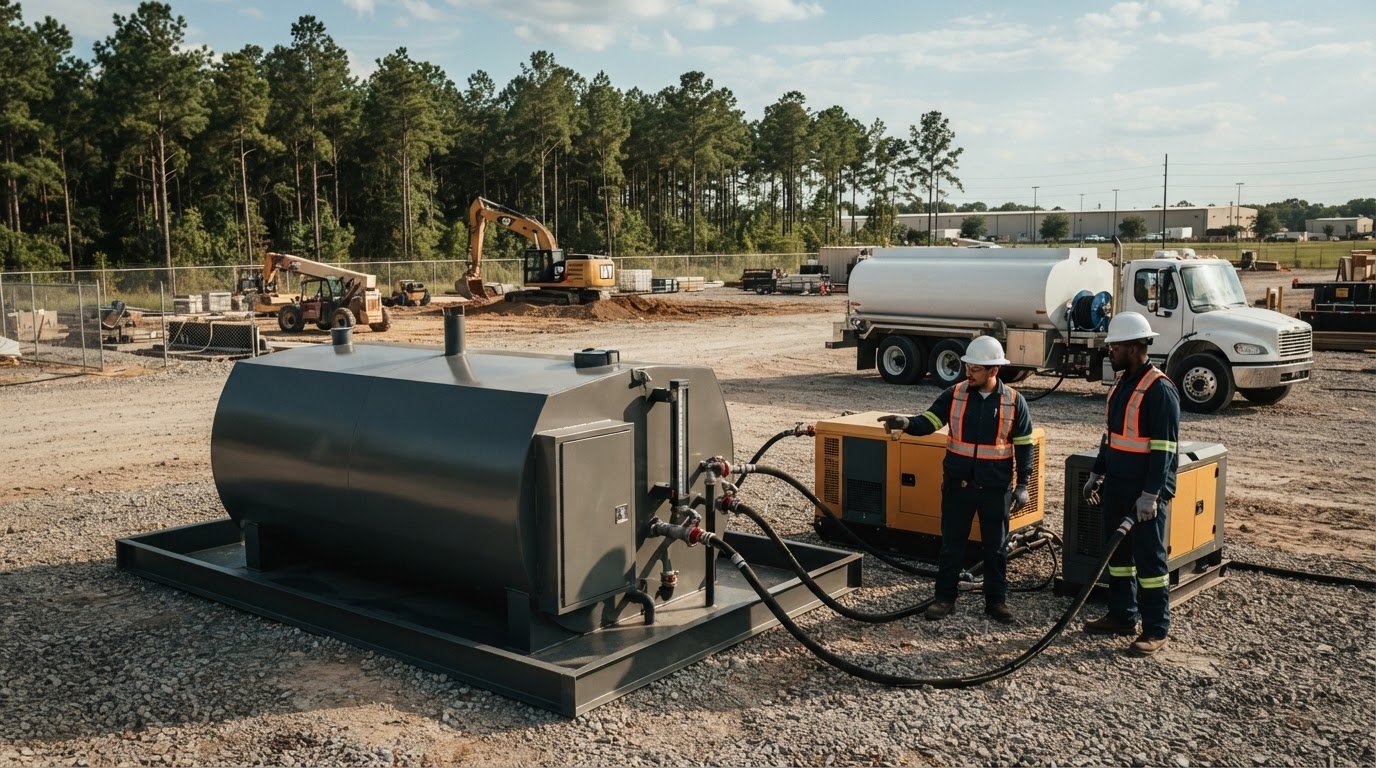
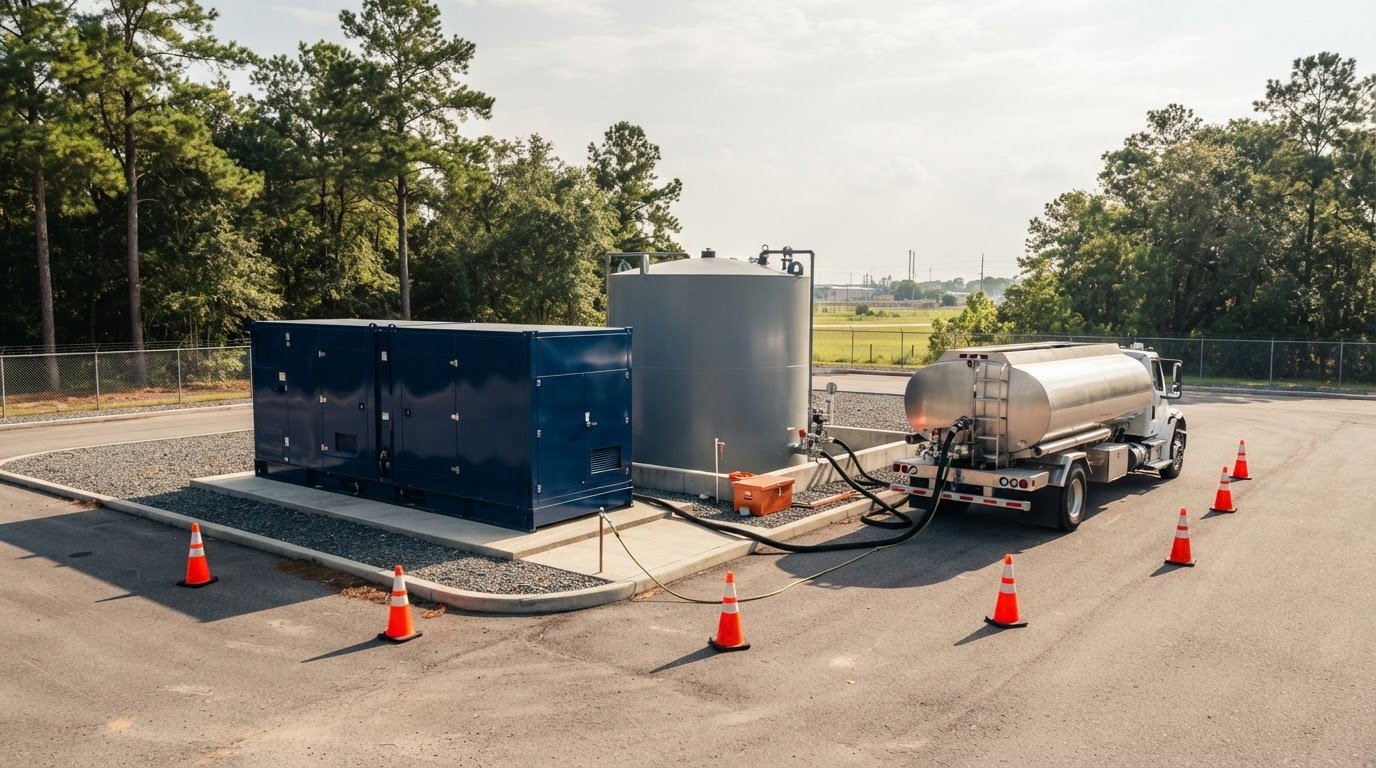
In Houston, floodwaters can isolate a medical campus in hours. Utilizing portable fuel tank rentals provides a critical "buffer" that standard underground tanks cannot match. These double-wall TransCube units are strategically placed in elevated parking structures or secure, high-ground enclosures. This foresight ensures that even if the primary fill ports are submerged or inaccessible, the hospital maintains a secondary, ready-to-use fuel source that bypasses immediate logistical barriers. These portable units serve as a frontline defense against the unpredictable nature of Gulf Coast flooding.
Real-Time Response: The Category 3 Hurricane Scenario
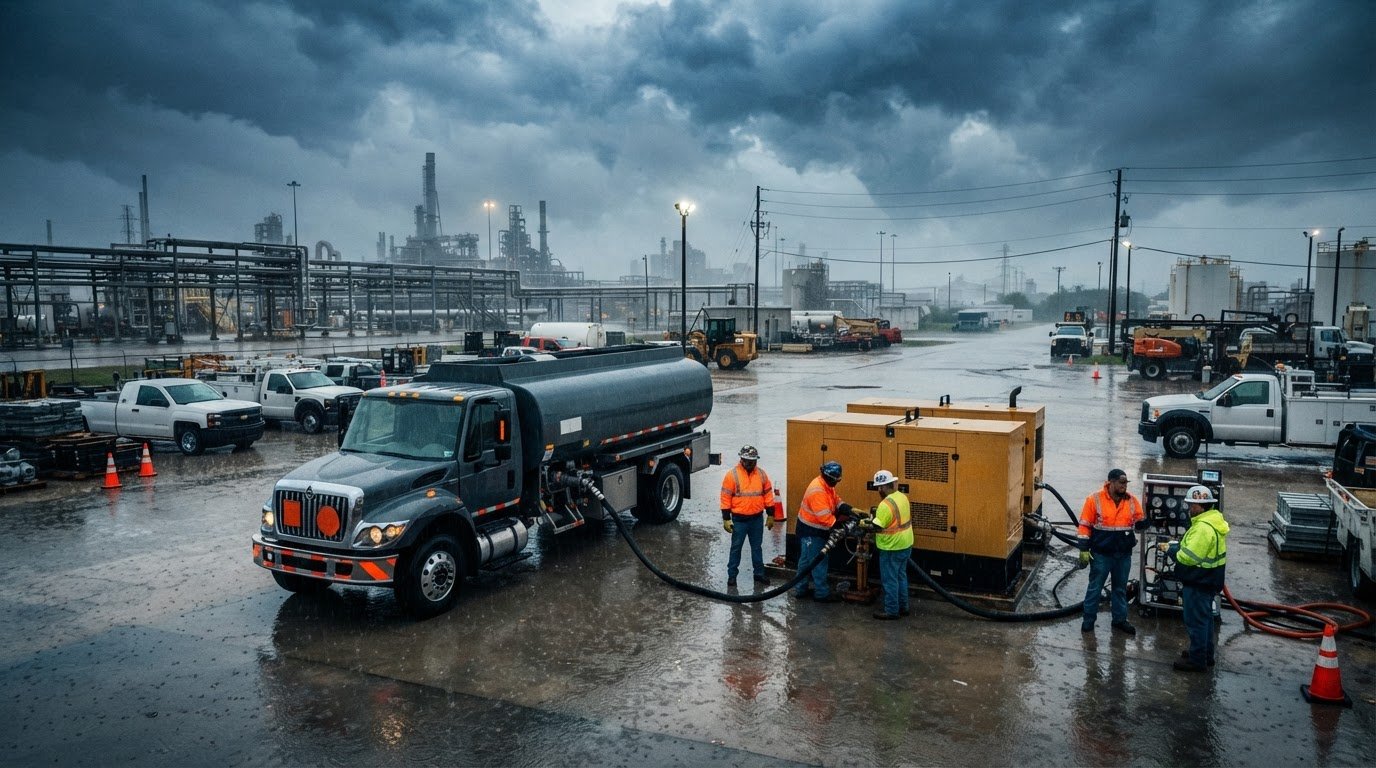
During a sustained grid failure, a large hospital complex may require upwards of 6,000 gallons of diesel daily to keep life-safety systems active. Effective hospital generator fueling houston relies on a fleet capable of navigating the aftermath. Our teams use 4WD fuel delivery vehicles to push through urban flood zones and debris-strewn paths where standard tankers would fail. We’ve managed scenarios where downed power lines blocked primary routes, requiring our dispatchers to use live telemetry and local knowledge to reroute deliveries without interrupting the burn rate.
This level of responsiveness is why healthcare facilities must audit their emergency plans before the first clouds appear on the horizon. Once the storm passes, we maintain high-frequency deliveries until the facility successfully transitions back to grid power, ensuring no gap in protection occurs during the grid testing phase. This methodical execution eliminates the "wait and see" approach that often leads to fuel exhaustion during a crisis.
Advanced Fuel Monitoring and Telemetry for Critical Infrastructure
Manual tank gauging relies on physical stick measurements that are prone to human error and logistical delays. In a high-stakes environment, a single miscalculation can lead to catastrophic system failure. Effective hospital generator fueling houston transitions from a reactive task to a proactive strategy through the use of live telemetry. By replacing manual checks with automated sensors, facilities eliminate the guesswork that often plagues emergency response efforts during a crisis.
Automated alerts serve as the frontline defense for your fuel supply. Our dispatch center receives real-time data from your tanks, triggering a fuel delivery long before levels hit the 25% critical mark. This buffer is essential for healthcare facilities where the transition from standby to prime power can happen without warning. Integrating these monitoring tools with professional generator fueling services ensures that your tanks are replenished based on actual consumption rather than a rigid, potentially inaccurate schedule.
Operational data also provides a clear audit trail for hospital administrators and regulatory boards. These reports document fuel levels, delivery timestamps, and consumption rates, which are vital for maintaining compliance with healthcare power standards. Having this information readily available simplifies the reporting process during inspections and ensures that your facility meets all necessary safety protocols.
How Telemetry Prevents Emergency Fuel Exhaustion
Modern sensors utilize ultrasonic or pressure-based technology to provide a real-time window into your fuel supply. This data feeds into cloud-based dashboards, allowing facility managers to monitor fuel levels from any mobile device or workstation. This visibility is particularly valuable during Houston storms when physical access to the generator site might be restricted. Modern telemetry systems provide granular data by measuring fuel volumes in precise gallon-level increments, allowing for surgical accuracy in dispatch planning.
Environmental Safety: Double-Wall Protection in Medical Zones
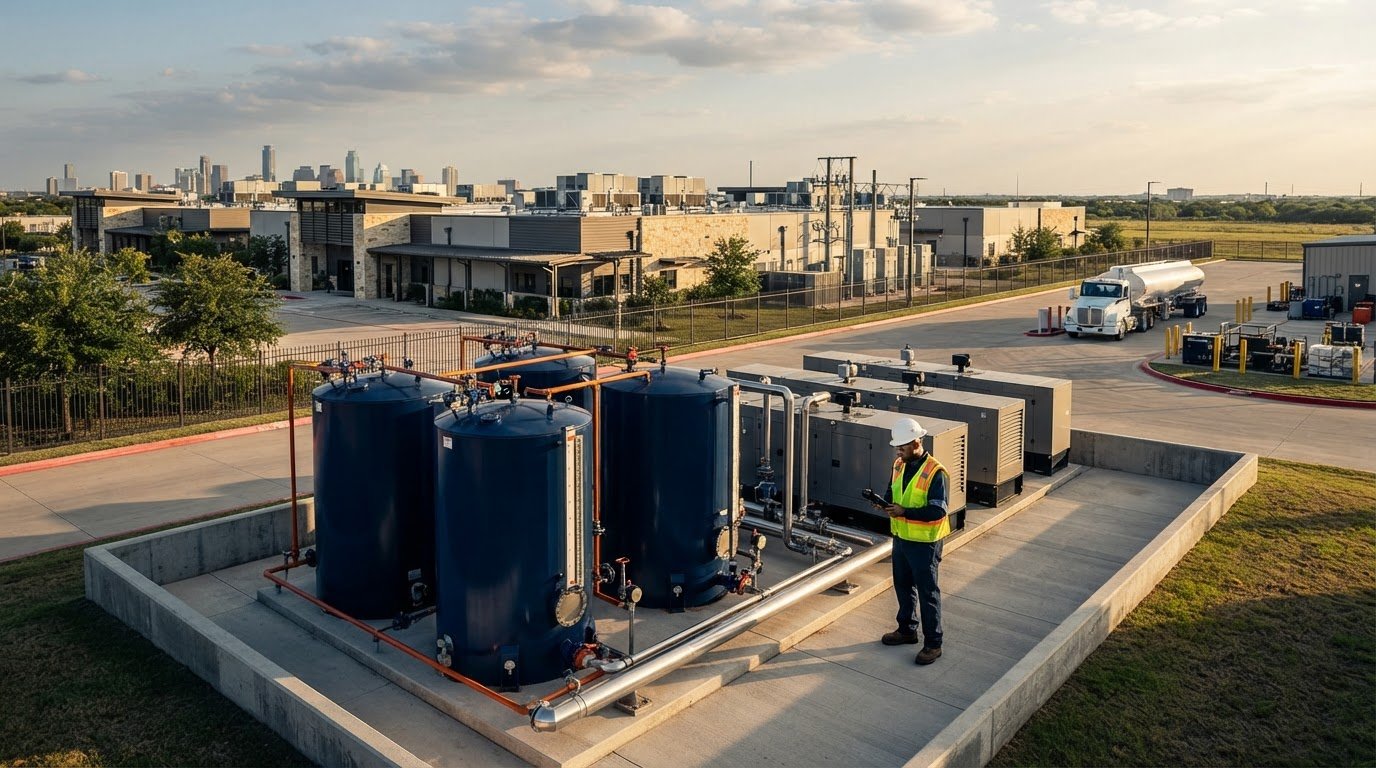
Hospitals operate under a zero-leak tolerance policy to protect patients and the local environment. On-site fuel storage must meet stringent EPA standards, especially during high-wind and heavy-rain events that increase the risk of ground contamination. Utilizing TransCube tanks provides an extra layer of security through double-wall containment. This design captures any potential primary tank leaks within an outer shell, preventing diesel from escaping into the surrounding soil or medical campus drainage systems. This proactive approach to containment ensures your facility remains compliant while maintaining a safe, clean environment for care.
Developing a 2026 Hospital Fuel Emergency Response Plan (ERP)
Establishing a resilient strategy for hospital generator fueling houston requires moving beyond basic maintenance into a state of constant readiness. Start the planning process by conducting a full-load generator test to establish an accurate consumption audit based on your facility’s current electrical demands. Follow this by securing a priority refueling contract with a provider capable of 24/7 response. This ensures your facility isn't competing for limited resources during a regional crisis. Define specific "Trigger Points" for pre-storm fuel topping and asset deployment to guarantee your tanks reach 100% capacity before the first rain bands reach the coast.
Adhering to NFPA 110 and local Houston fire codes is a core requirement for hospital generator fueling houston. These standards govern the installation, maintenance, and testing of emergency power systems. Part of this compliance involves scheduling regular fuel quality testing to prevent microbial growth, which is a significant risk in the humid Gulf Coast environment. This methodical planning ensures that when your facility transitions to prime power, the fuel is chemically stable enough to support the entire load without risking engine failure.
Regulatory Compliance: NFPA 110 and CMS Requirements
Federal regulations under 42 CFR 482.15 require hospitals and Critical Access Hospitals to maintain a plan for at least 96 hours of continuous operation during a power outage. This mandate is typically met through a combination of on-site storage and verified resupply contracts. Utilizing a scheduled diesel delivery service supports the rigorous testing cycles required by the Joint Commission (TJC). Accurate documentation of every fuel drop is essential for passing these audits and proving your facility’s ability to withstand extended grid failures without interruption.
Fuel Quality Management: Preventing Generator Failure
Standby diesel is highly susceptible to degradation over time. In Houston, high humidity leads to condensation inside tanks, which promotes the growth of algae and bacteria that can clog filters instantly. This "stale" fuel causes engine surging or total failure exactly when the system is under maximum load. Implementing a fuel additive program and regular polishing keeps your supply ready for immediate use. Refer to our 2026 Fuel Delivery Guide for Standby Generators for detailed maintenance intervals and quality control tips.
A robust ERP is a living document that requires a vigilant partner to execute. Don't wait for a tropical depression to form in the Gulf before finalizing your logistics. Contact our specialists today to schedule a pre-storm audit and secure your 2026 priority fueling agreement.
React Fueling: Your Houston Partner for Guaranteed Generator Uptime
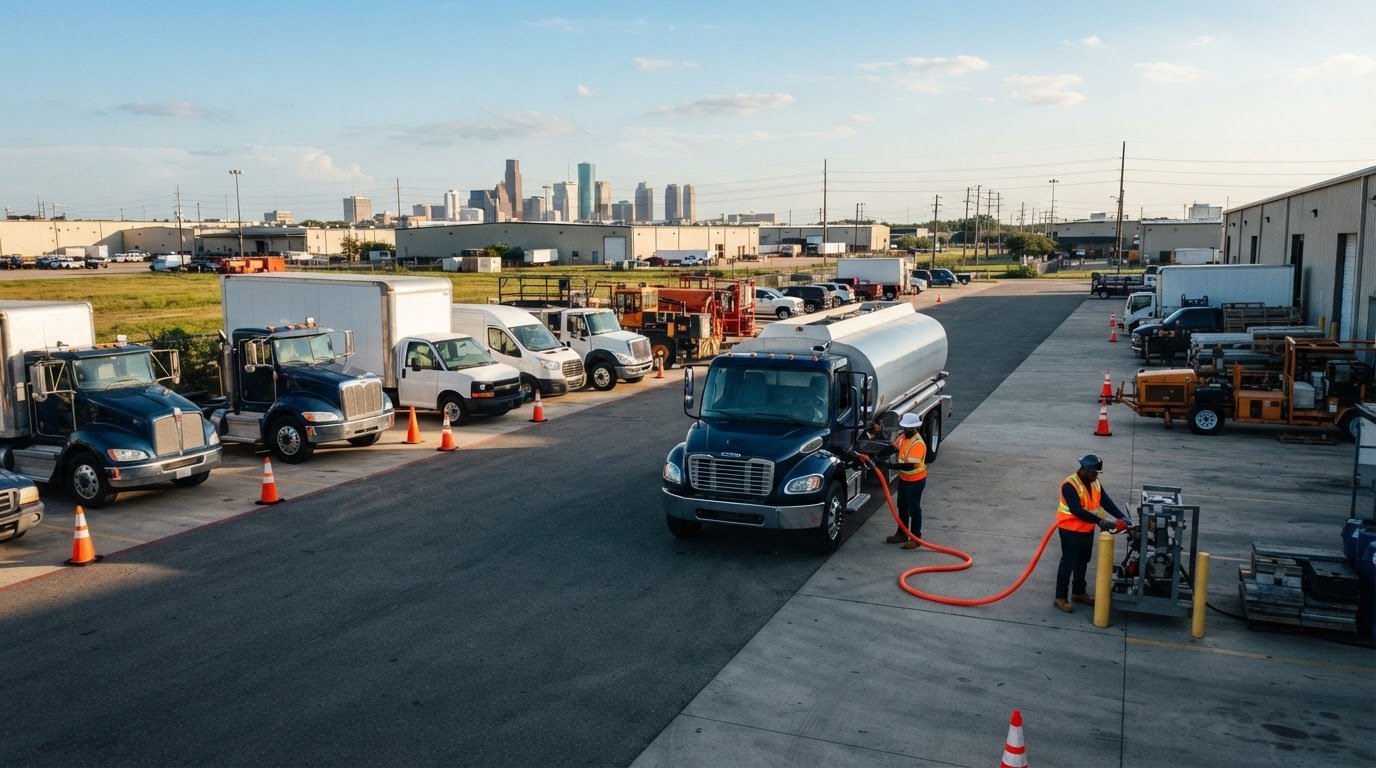
React Fueling operates as a specialized division of the React Holdings family, combining local Houston knowledge with industrial-scale logistical capabilities. Our team functions as a "Vigilant Partner," providing the foresight needed to prevent interruptions before they occur. We understand that hospital generator fueling houston isn't a commodity service; it's a critical support system that requires total control over the supply chain. This local presence allows us to monitor regional weather patterns and infrastructure conditions in real-time, ensuring we show up when it matters most.
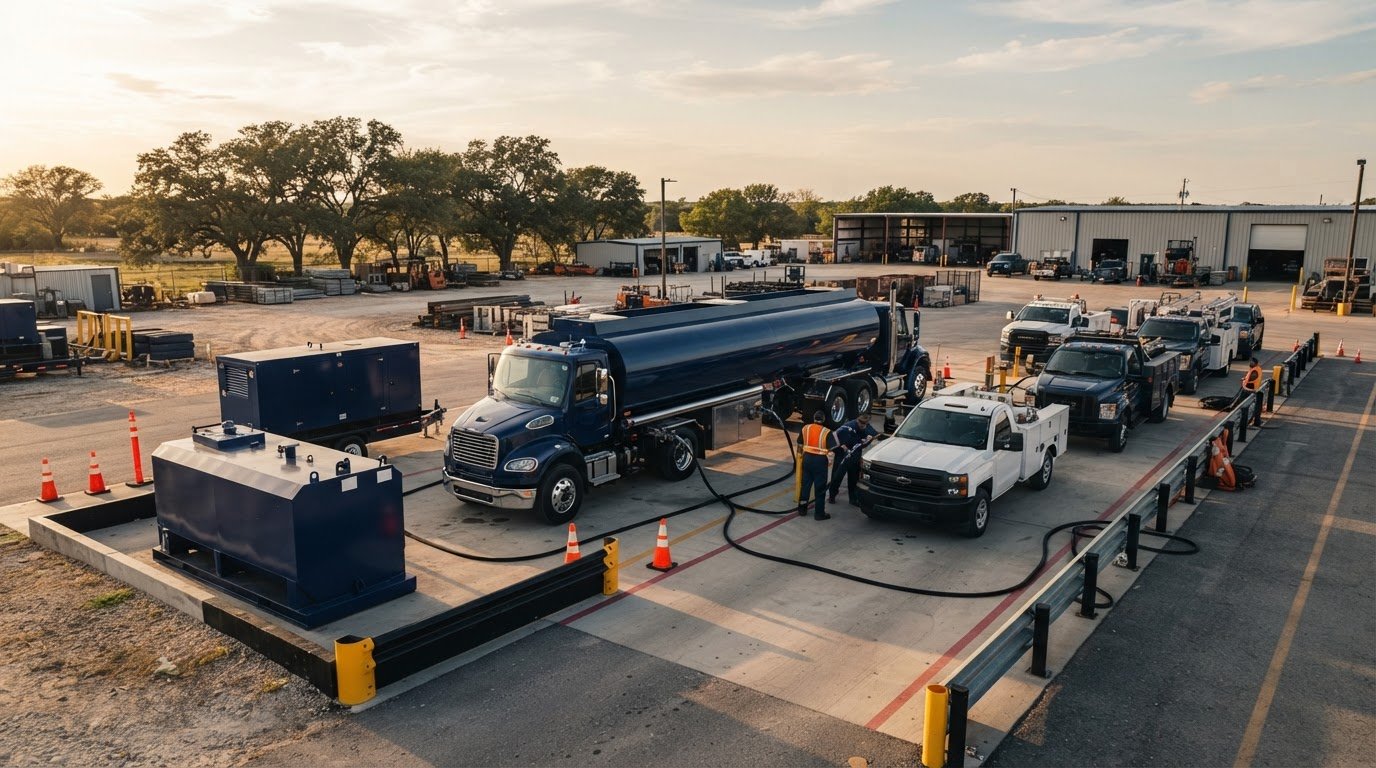
Our "Direct-to-Equipment" fueling model delivers diesel directly into your generator's belly tanks or auxiliary storage units. This approach is significantly faster and safer than traditional bulk drops, as it eliminates the need for your facility staff to manage fuel transfers. By handling the entire process from transport to the final fill point, we maintain a closed-loop system that reduces the risk of spills and ensures your equipment is ready for immediate load-bearing. This service is a core component of our equipment fueling service, designed for high-stakes industrial and medical environments.
24/7 Emergency Readiness in Houston
Our 24/7 emergency response capability is a non-negotiable standard for healthcare providers. During Category 3 hurricanes and sudden grid failures, we deploy specialized equipment including double-wall TransCube tanks and telemetry-enabled trucks. These assets allow us to maintain a constant presence in the field, bypassing the logistical bottlenecks that often paralyze general-purpose fuel providers. This commitment to 24/7 emergency fueling means your facility never waits at the back of a delivery queue when every minute counts. We maintain a fleet of 4WD vehicles to ensure we can navigate the debris and floodwaters that often follow major Gulf Coast storms.
Custom Fueling Solutions for Healthcare Networks
We scale our services to meet the demands of diverse healthcare networks, from standalone surgical centers to sprawling multi-campus systems. Our management team provides consolidated reporting and billing, giving facility managers a clear view of fuel consumption and compliance data across all locations. This administrative efficiency allows your team to focus on patient care while we handle the physical reality of energy resilience. By integrating generator fueling service with real-time telemetry, we provide a level of operational continuity that traditional vendors cannot match for hospital generator fueling houston. Contact our Houston team to start your emergency fuel audit and don't leave your facility's power to chance during the next high-stakes event.
Ensuring Continuous Care Through Every Houston Storm
Maintaining power in a medical facility requires more than just a standby generator; it demands a logistics strategy built on foresight and precision. Shifting from reactive, on-call refueling to a proactive model ensures that life-safety systems never flicker during a grid failure. You've seen how integrating live telemetry and pre-positioned assets like TransCube tanks creates a vital buffer against the unpredictable flooding of the Gulf Coast.
Reliable hospital generator fueling houston depends on a partner that operates with a "boots-on-the-ground" mentality. Our 24/7 Emergency Response Team utilizes Real-Time Telemetry Monitoring to track every gallon while our FEMA-Compliant Logistics ensure we navigate the most restrictive disaster zones safely. These layers of protection allow administrators to focus on patient outcomes rather than fuel levels.
Don't wait for a tropical system to test your facility's resilience. Secure Your Critical Power: Request a Hospital Fueling Audit today to build a more stable future for your healthcare network. We're ready to stand with you when it matters most.
Frequently Asked Questions
How much diesel does a hospital generator typically use per hour?
Consumption varies by generator size and load demand. A large 2MW generator typically burns approximately 140 gallons per hour at full capacity. For a multi-generator campus, this rate often exceeds 300 gallons per hour during a total grid failure. Accurate load calculations are essential for hospital generator fueling houston to ensure your on-site storage meets the minimum 96-hour federal requirement during extended outages.
What is the NFPA 110 requirement for hospital fuel storage?
NFPA 110 provides the standard for emergency and standby power systems, focusing on installation, maintenance, and testing. While NFPA 110 sets the technical benchmarks, CMS regulations specifically mandate that hospitals maintain at least a 96-hour fuel supply. This is achieved through a combination of on-site tank capacity and guaranteed resupply contracts with a dedicated fuel partner capable of operating during regional disasters.
Can fuel delivery trucks reach hospitals during a Houston flood?
Standard tankers often fail during severe flooding, but specialized response teams use 4WD delivery vehicles to navigate urban flood zones. We mitigate road closure risks by pre-positioning double-wall TransCube tanks on high ground or in elevated parking structures before the storm makes landfall. This proactive strategy ensures fuel is accessible even when primary supply routes are temporarily submerged or blocked by debris.
What is fuel telemetry and why do hospitals need it?
Fuel telemetry uses ultrasonic or pressure-based sensors to monitor tank levels in real-time. This technology eliminates human error associated with manual gauging and provides automated alerts when levels drop. Hospitals require this precision to manage high burn rates during outages. Telemetry allows our dispatchers to time every hospital generator fueling houston delivery perfectly, ensuring your facility never reaches a critical low-fuel state.
How often should hospital generator fuel be tested for quality?
Industry standards and NFPA 110 guidelines generally require annual fuel quality testing to ensure reliability. However, Houston’s high humidity often necessitates more frequent semi-annual checks to monitor for condensation, microbial growth, and sediment. Regular testing prevents "stale" fuel from clogging filters or damaging injectors when the generator transitions to a full load during an emergency power event.
Does React Fueling provide fuel for hospitals outside of Houston?
Our primary focus is providing specialized, 24/7 support within the Greater Houston area and along the Gulf Coast. As a member of the React Holdings family, we utilize our deep local knowledge and specialized equipment to serve the unique logistical needs of this region. This concentration allows us to maintain the rapid response times and "boots-on-the-ground" presence that critical healthcare infrastructure requires.
What are the benefits of renting a portable fuel tank for a hospital?
Portable fuel tank rentals provide essential redundancy beyond fixed underground storage. These double-wall units offer environmental protection and can be moved to secure, elevated locations to avoid floodwaters. Using portable tanks allows facilities to scale their fuel capacity temporarily during peak hurricane season. This flexibility ensures that your generators have a dedicated, secondary fuel source that remains accessible even if primary fill ports become unreachable.
How do I set up an emergency fuel contract for my medical facility?
Establishing a contract begins with a comprehensive fuel audit of your campus. Our team assesses your generator burn rates, existing storage capacity, and logistical access points to develop a customized Emergency Response Plan. This agreement secures your priority status for 24/7 deliveries and pre-positioned assets. Don't wait for a crisis to secure your supply. Contact our Houston specialists to finalize your ERP before the next major weather event.
Recent Posts